


Affiliate marketing for retirees is one way to earn online, but how does it compare with freelancing, selling crafts, or taking surveys? The right choice depends on your budget, schedule, and how soon you need income.
If you’ve started looking into online income, you’ve probably noticed there’s no shortage of options. Freelancing, selling crafts, taking surveys, consulting, affiliate marketing. Every one of them promises a way to bring in money from your laptop, and every one of them has someone online insisting it’s the best choice. For a retiree, though, “best” depends entirely on what you’re optimizing for. Chasing the fastest payout is a different goal than building something that keeps paying you without taking over your days. This article walks through the main options side by side, measured against what actually matters at this stage of life.
Online Income Options at a Glance
Each option comes with different costs, time demands, and trade-offs.
Freelancing and consulting
You can use your work experience, but earning depends on continuing to serve clients and meet deadlines.
Selling crafts or goods
You can sell something tangible, but you may need to buy materials or stock, store items, pack orders, and handle shipping.
Surveys and gig apps
They can be easy to start, but the income depends on continuing to complete tasks, and the hourly return may be low.
Affiliate marketing
There is no inventory to ship, but building an audience and learning the basics takes time.
What retirees actually need from an online income, before picking a method
Before comparing methods, it helps to name the criteria, because most comparisons online skip this step entirely.
At this stage of life, the things that matter most tend to be:
- Low upfront cost. You shouldn’t need to risk a meaningful chunk of your savings to find out if something works.
- No inventory or shipping. Storing boxes, printing labels, and standing in line at the post office isn’t retirement. It’s a part-time job with extra steps.
- No deadlines or bosses. One of the real gifts of retirement is control over your own schedule. Any income method that hands that control back to someone else is working against you.
- Income that doesn’t require trading hours for dollars forever. A method where you earn only while you’re actively working caps what your time is worth. A method that can keep paying after the work is done doesn’t have that ceiling.
With those four in mind, here’s how the usual suspects actually hold up.
Freelancing and consulting: good money, but you’re still punching a clock
Freelancing and consulting put your decades of work experience to direct use, and that’s a genuine strength. If you spent thirty years in accounting, marketing, teaching, or management, there are people who will pay for that knowledge today, often at a solid hourly rate.
The catch is in the structure, not the pay. Freelancing and consulting are built on trading hours for dollars. Take a week off and the income stops. Decide to stop entirely, and the income stops immediately, with nothing continuing to come in behind you. There are also deadlines to hit and clients to satisfy, which can start to feel a lot like the job you retired from, just with a different name on the paycheck.
For some retirees, that’s fine. If you enjoy the work itself and want a flexible version of your old career, consulting can be a good fit. But if the goal is income that doesn’t depend on you showing up every single week, freelancing and consulting don’t solve that problem. They just move the clock-punching online.
Selling crafts or goods online: the inventory and shipping problem nobody mentions
Selling handmade goods or sourced products online sounds appealing because it feels tangible. You make or find something, someone buys it, you ship it, and you get paid. Simple enough in theory.

In practice, this path comes with a set of chores that rarely get mentioned in the pitch: buying materials or stock, storing it somewhere in your home, packaging each order, printing labels, making trips to the post office or arranging pickups, and handling the occasional damaged item or return. Multiply that by every single sale, and what started as a creative outlet can turn into a logistics operation.
There’s also the upfront cost to consider. Materials, packaging supplies, and sometimes a platform fee all come out of pocket before a single sale happens, and there’s no guarantee the items will sell at a price that covers the time involved. For retirees on a fixed income, that risk is worth weighing carefully.
Selling crafts online can still be a genuinely enjoyable way to spend time, and some people do turn it into steady income. But measured against the four criteria above, it fails on inventory and shipping right out of the gate, and the income still depends on continuing to make and ship things.
Surveys and gig apps: why the hourly math rarely works out
Online surveys and gig apps get recommended constantly because they’re easy to start. No experience, no investment, just sign up and begin. That low barrier is real, but it hides a problem that shows up the moment you do the math.
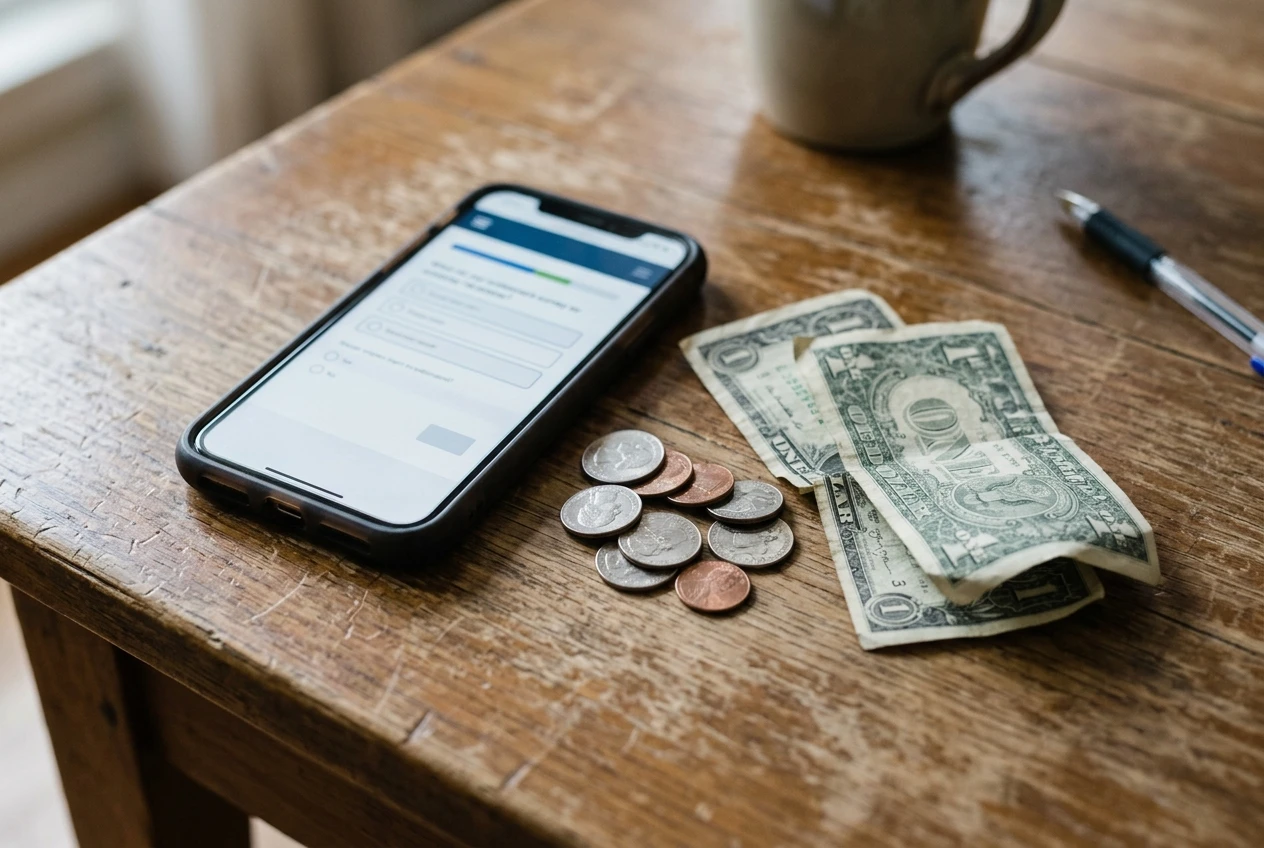
Most surveys pay a dollar or two for fifteen to twenty minutes of your time. Gig apps for tasks like data entry or transcription often land in a similar range once you account for the time spent searching for work and reading instructions. Break that down to an hourly rate, and it’s often well below what you’d expect for the effort, sometimes just a few dollars an hour.
The deeper issue is the same one that applies to freelancing: this income only exists while you’re actively doing the task. There’s no carryover, no momentum, no commission still arriving next month for work you did last month. Every dollar requires a fresh unit of your time, right now. For a retiree looking to supplement income without it eating into the hours you’d rather spend elsewhere, surveys rarely pay enough to justify the time they take.
Affiliate marketing: recommend what you already use, let the commission keep arriving
Affiliate marketing works differently from all three of the options above, and the difference matters most at this stage of life.

The basic idea is this: you write about or recommend products and services you genuinely find useful, you include a link, and when someone clicks that link and makes a purchase, you earn a commission. There’s no product to make, store, or ship, no client to answer to, and no shift to show up for. You write something once, it gets found by search engines or shared, and it can keep earning from that same piece of content for months or years afterward.
That last part is the key difference against everything else on this list. A freelance hour spent is gone once it’s paid for. A survey completed pays once. But an article or recommendation that keeps attracting readers can keep generating commissions without you doing the work again. It’s the only option on this list where the income isn’t capped by how many hours you’re willing to put in today.
Affiliate marketing for retirees also fits the practical criteria well. The upfront cost is low, there’s no inventory sitting in a closet, no deadlines imposed by anyone but you, and no boss checking in. You set the pace, write on your own schedule, and build it around the time and energy you actually have, rather than the time a job demands of you.
FUN FACT
Amazon began as an online bookstore
Jeff Bezos founded Amazon in 1994. In July 1995, it opened as an online bookseller from his home in Bellevue, Washington. That home garage served as the company’s early base. Amazon says its first book sale was Fluid Concepts and Creative Analogies by Douglas Hofstadter.
The lesson is not that every small business will become Amazon. It’s that a big idea can start with a focused first step.
The honest downsides of affiliate marketing, and why they’re still the smaller risk
It wouldn’t be fair to leave out the downsides, so here they are plainly.
Affiliate marketing doesn’t pay right away. Building an audience of readers who trust your recommendations takes time, usually months rather than days, and the first commission rarely arrives in week one. It also requires learning some new skills: writing content that helps people, understanding the basics of how search engines find that content, and getting comfortable with a few pieces of software you may not have used before.
Compare that against the downsides of the other options, though. Freelancing’s downside is that the income stops the moment you stop working, permanently. Selling crafts’ downside is ongoing cost, storage, and shipping labor with every sale. Surveys’ downside is an hourly rate that often isn’t worth the time spent. Affiliate marketing’s downside is a slower start in exchange for income that doesn’t require you to keep trading hours once it’s built. For most retirees, that’s a trade worth making.
Plan for a Learning Phase
Building an audience and creating useful content can take time. There is no guaranteed timeline for earning a commission.
Early work may include writing helpful content, learning how people find it, and getting comfortable with new tools.
How to tell if this is the right fit for your situation
Affiliate marketing tends to suit retirees who have some patience for a slower start, enjoy writing or talking about things they know well, and want their income to eventually require less of their time rather than more. If you’re drawn to a topic you already know a fair amount about, whether that’s gardening, travel, a hobby, or something from your working years, that familiarity becomes a real advantage once you start writing about it.
It may not be the right fit if you need income immediately, or if the idea of learning new online tools feels more stressful than interesting. That’s a fair thing to weigh, and it’s worth sitting with before committing your time to it. If finding a topic that fits you feels like the harder part, Finding Your Passion After Retirement: Your Second Act Starts Here walks through how to think about that before you build anything around it.
Is Affiliate Marketing Worth Exploring for You?
It may be worth exploring if you:
- Can be patient while you learn and build an audience.
- Enjoy writing or talking about subjects you know well.
- Are comfortable with income being uncertain.
Think it over if you:
- Need income right away.
- Would find learning online tools stressful.
- Would rather not create content or maintain a website.
Meet Ace: the guide built into Wealthy Affiliate’s new member experience
If affiliate marketing sounds like the direction worth exploring, Wealthy Affiliate is built specifically to walk you through it without assuming any technical background. Inside, you’ll find Ace, a built-in assistant that answers your questions as they come up, along with a Learn tab that breaks the process into manageable Focuses you can move through at your own pace. There’s also a Studio where you can put together your site and your content without needing to know how to code. None of it requires guessing what to do next on your own.
If this comparison has you leaning toward giving affiliate marketing a real look, the next step is Thinking About Earning Online After Retirement? Start Here, which lays out exactly how to begin.
Want to Explore Affiliate Marketing?
I’m Michael, also known as TheAmazingMG on the Wealthy Affiliate platform. If you decide to check it out, I’ll be glad to be your personal mentor and guide whenever you need help.
You’re warmly invited to take a look and explore Wealthy Affiliate for free.
Explore Wealthy Affiliate for FreeThis is an affiliate link. I may earn a commission if you sign up through it.