

If you want to earn money online in retirement, start by learning how to spot scams, set a spending limit, and test low-cost options.
If you are asking how retirees can safely make money online, you have already started in the right place. Most of the damage in this area happens to people who moved fast, paid for something before understanding it, and discovered the problem afterward. You can move slowly, and you can decide in advance how much you are willing to lose.
This guide gives you a sequence to follow: recognize scams, set a spending limit, choose one low-cost way to begin, and try things before you pay. It does not promise any income figure, because nobody can honestly promise one to a stranger.
Why caution is your biggest advantage when you start online
Many people your age worry that they are too late, and that younger people will always be quicker with technology. Speed matters very little here. Most online income methods reward reliability, clear communication, and good judgment, and those are things a long working life tends to build.
Caution is also what protects your savings. A person who reads the terms, asks questions, and waits a few days before paying will avoid most of the traps described below. Impatient beginners are the ones who get caught, whatever their age.
The technology is learnable in small pieces. You do not need to understand everything about the internet. You need to be comfortable with email, a web browser, and one or two tools for the specific kind of work you choose. That is a smaller list than it sounds.
Five warning signs of an online income scam (and what to do when you spot one)
Scams change their wording constantly, but they rely on a handful of patterns. Learn these, and you can recognize most of them even when the details are new.
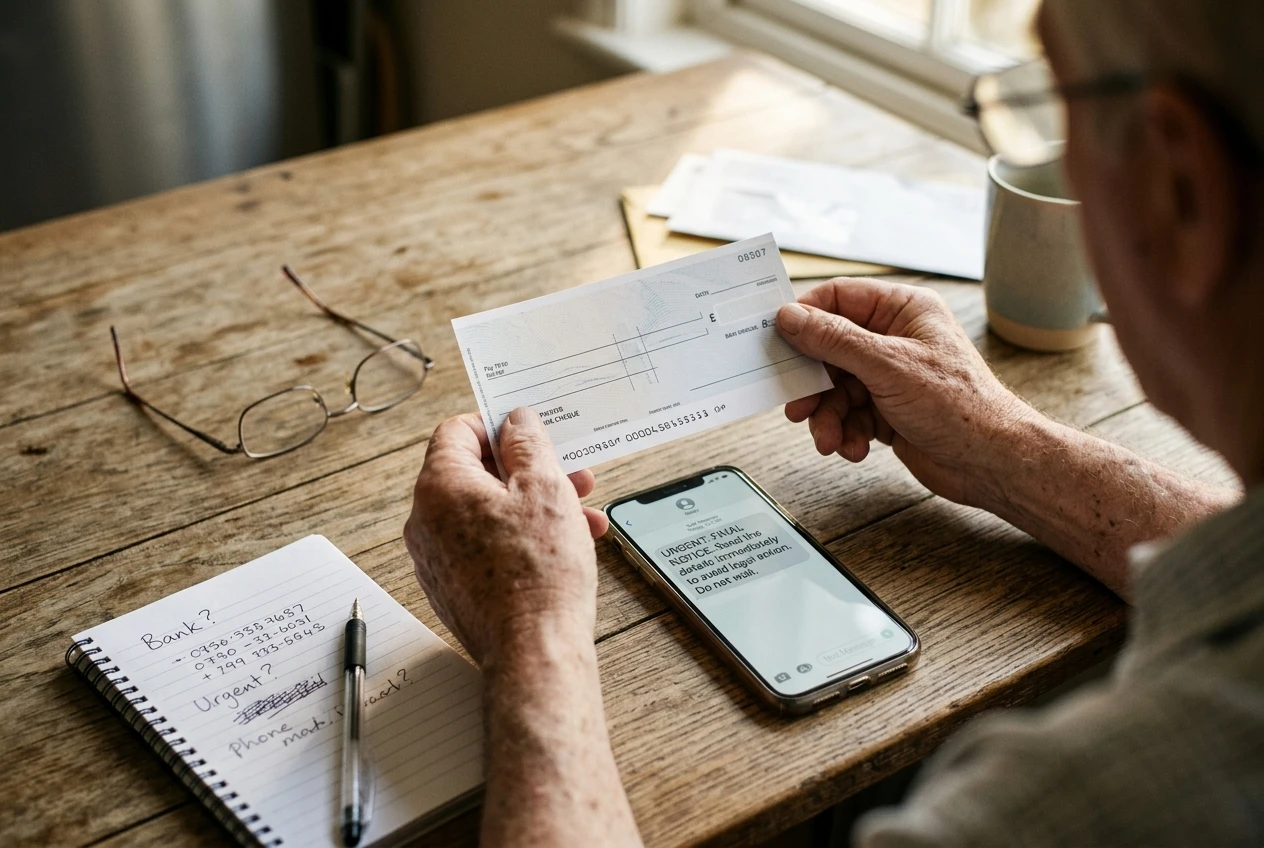
- A guaranteed income or “no risk” promise. Real work and real businesses have variable results. Anyone who guarantees what you will earn is selling you a feeling, not a fact.
- You are asked to pay to get hired. Legitimate employers and clients do not charge you for a job, for “training materials” required to start, or for a background check you never requested. Money flows toward you in real work.
- Pressure to decide now. Countdown timers, “only three spots left” and “this price ends tonight” exist to stop you from thinking. A good offer will still be there after you have slept on it.
- Unusual payment requests. Gift cards, wire transfers, cryptocurrency sent to a stranger and cheques that arrive with extra money (“keep your share, send back the rest”) are standard fraud tools. A cheque can look real and later bounce, leaving you owing the bank.
- Vagueness about the actual work. If you cannot get a plain answer to “What exactly would I do each day, and who pays me for it?”, walk away. Offers that talk only about lifestyle and freedom, and never about a task or a customer, usually have nothing behind them.
When you spot one of these, stop replying. Do not argue, and do not click any link in the message. If you have already shared bank or card details, call your bank right away and ask them to protect the account. You can also report the offer to your country’s consumer protection agency, such as the FTC in the United States, which helps other people avoid it.
Contact you did not ask for deserves extra suspicion. A message that arrives unprompted on social media or by text, offering easy work, is far more likely to be a scam than an opportunity you found yourself.
Decide your spending ceiling before you look at a single offer
Set your limit first, while you are calm and no one is selling to you. Once you are looking at a persuasive sales page, it is much harder to be objective about what is reasonable.
Choose an amount of money that you could lose completely without changing how you live. A useful test is to ask whether losing it would make you skip a bill, delay a medical expense, or worry at night. If the answer is yes, the amount is too high. Write the number down somewhere you will see it.

A few rules that go with the ceiling:
- Use only spare cash. Never draw on retirement accounts, emergency savings, or credit you could not pay off in full.
- Count everything. Tools, courses, subscriptions, and trial periods that turn into paid plans all count toward the same limit.
- Wait before any purchase. Give yourself a fixed waiting period, such as a few days, between deciding you want something and paying for it.
- Treat the ceiling as a total, not a monthly amount. When you have spent it, pause and review what you have actually gained before raising it.
You may find that the ceiling is very low, and that is fine. Several good ways to begin cost nothing at all.
Low-risk ways to begin: freelancing your existing skills, selling what you know, and simple online work
The safest starting point is something you already know how to do. You do not need to learn a new craft and a new technology at the same time. Pick one of the paths below and ignore the rest for now.
Freelancing your existing skills
If you spent years in bookkeeping, teaching, nursing administration, project management, writing, editing, sales or a skilled trade, someone online may pay for that knowledge. Freelance marketplaces and direct outreach to small businesses are common ways to find those people. Examples include proofreading, tutoring, bookkeeping support, writing, and helping small organizations get their paperwork in order.
The main cost is your time. Your first clients may pay less than you would like while you build a track record, so expect to treat the early jobs as practice with a paycheck attached, not as full replacement income.
Selling what you know
If you can explain something well, you can package that explanation. People write short guides, record lessons, run a small website on a subject they understand, or coach individuals one-to-one. Gardening, genealogy, woodworking, a language, tax basics for new retirees, and travel on a budget are the kinds of subjects people search for.
This route is slower, because you build an audience before you earn from it. It also suits patient people, since the work you do now keeps being useful later. Some sites like this earn through affiliate commissions, which means recommending a product and being paid if a reader buys it. That is how this site is funded, and it only works when the recommendations are honest.
Simple online work
Some people prefer tasks with clear instructions: data entry, transcription, online customer chat support or testing websites. Pay and availability vary widely between companies, and some of these roles pay little for the time they take. Before you start, find out what each task pays, how and when you are paid, and whether you must buy anything first. If you must pay to begin, treat it as a warning sign from the list above.
Learning first: how to try a method before you pay for anything
You can learn a surprising amount without spending money, and it is worth doing so before you commit to any paid course or software.
Start with free material. Your public library may offer free online courses, and video tutorials cover almost every beginner topic. Read a few different explanations of the same method, and notice whether they agree with each other. If one source promises results the others never mention, be careful with it.

Then try the work in a small way. If you are interested in writing, write a sample piece and ask a friend to read it. If you are considering tutoring, offer an hour to someone you know. A small trial shows you whether you enjoy the work, which matters as much as whether it pays.
When you do consider a paid product, check these things first:
- Is there a free trial or a free plan? Use it fully before you pay.
- What is the cancellation process? Find out how to stop the plan before you start it, and set a reminder for a day or two before a trial ends.
- What is the refund policy? Read it in the terms, not just on the sales page.
- Who is behind it? Look for independent reviews from people who are not being paid to praise it, and search the product name together with the word “complaints”.
If a seller will not let you look around before you pay, that tells you something.
Thinking about a website of your own?
There is no need to add another monthly bill before you have a reason for it. If a website becomes part of your plan, Wealthy Affiliate is one option to explore. Check what is included and what it costs, then decide whether it fits your budget.
Take a look at Wealthy Affiliate →Affiliate link: I may earn a commission if you purchase through this link.
Simple tools worth having, and what they actually cost
You probably already own most of what you need. A computer or tablet that connects reliably to the internet, an email address used only for this work, and a phone for verification codes cover the basics.
Beyond that, a few kinds of tools are useful:
- A password manager. It stores a different strong password for each account, so one leak cannot open everything. Several well-known ones have free versions.
- A word processor and spreadsheet. Free online versions exist and are enough for most beginners.
- A simple design tool, if you will make documents or images. Many have free plans that cover basic needs.
- A payment account, such as one from a major, well-known provider, so clients can pay you without receiving your bank details directly.
- A website builder or hosting plan, only if you decide to build a site of your own. This is usually the first real recurring cost.
Prices change, and plans differ by country, so I will not quote figures that may be out of date. Check the provider’s own pricing page before you sign up, and compare it against your spending ceiling. Where a tool has a free version, start with that and upgrade only when you are hitting a limit that actually slows your work.
Some of the tools and training we recommend pay us a commission if you sign up through our links. We list the ones with a free trial first, so you can judge them with your own eyes before any money leaves your account.
What a realistic first three months looks like
Nobody can tell you what you will earn, and anyone who gives you an exact figure for the first three months is guessing. What can be described is the work.

Month one: set up and learn. Choose one path from the section above. Set your spending ceiling, create a separate email address, and install a password manager. Spend your time on free tutorials and small practice tasks. Spending nothing this month is a perfectly good result.
Month two: try it for real. Offer a first piece of work, publish a first article, or apply for a first small task. Expect some replies to be slow and some people to say no. Keep notes on what you tried, how long it took, and what happened.
Month three: review honestly. Look at your notes. Did you enjoy the work? Did anyone respond positively? What would you change? If something shows promise, spend a little more time on it, and consider whether a paid tool would genuinely save you effort. If nothing worked, try a different path before spending anything.
Some people earn something in this period, and some earn nothing. A slow start does not mean you are too old or too late. It usually means you are still learning where your skills are in demand.
Keeping your personal details safe while you work online
Real clients and employers need very little of your personal information at the start. A name, an email address, and a way to pay you are usually enough. Be cautious with anything beyond that.
- Do not send your Social Security number, national ID or full bank login to anyone before a signed agreement, and even then only through a channel you have verified. Tax forms come after you have actually been hired.
- Use a separate email address for online work, so scam messages stay away from your main inbox.
- Turn on two-step verification for email, payment accounts and any marketplace profile.
- Never share a verification code with anyone, whatever reason they give. Real companies do not ask for them.
- Keep work and personal money apart if you can, with a separate account for payments you receive.
- Check the web address before you enter a password. Type the site’s name yourself instead of clicking a link in a message.
It is fair to ask the same of any site you visit, including this one. You can read exactly how we handle information on our privacy page, written in plain English.
If you are ready for the next step, take a look at the beginner tools and training we recommend, starting with the ones that offer a free trial so you can try before you spend anything.